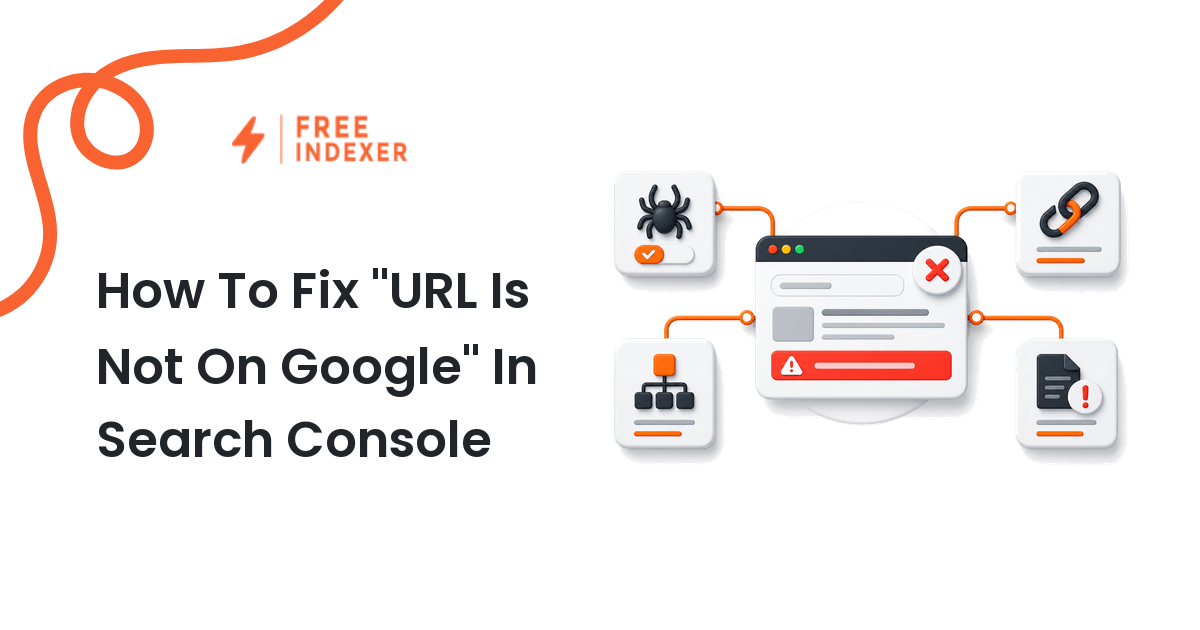
Diagnose the "URL is not on Google" message by separating discovery, crawl access, canonical, content, and timing problems.
For website owners, the practical goal is simple: Resolve the reported blocker, verify the live page, and then schedule a measured follow-up.
Related FreeIndexer reading:
- Google Search Console Indexing Guide
- Why Google Is Not Indexing My URL
- Request Indexing In Search Console
What The Signal Means
The message is a starting point, not a diagnosis. Read the detailed reason, test the live URL, and determine whether Google has not discovered the page, cannot crawl it, selected another canonical, or chose not to index it.
Evidence To Collect Before Changing Anything
- The inspection result names a specific reason or shows that the URL is unknown.
- The live test can differ from the indexed result because it reflects the current page rather than Google's stored version.
- A successful live test does not guarantee indexing; it confirms that the current URL can be fetched and processed.
- The next action depends on the reason, not on repeatedly clicking Request Indexing.
Diagnostic Decision Table
| Step | Check | Evidence To Capture | Corrective Action |
|---|---|---|---|
| 1 | Read the exact reason | Coverage reason and referring sitemap | Classify the issue as discovery, crawl, canonical, quality, or timing. |
| 2 | Run a live test | Fetch result, screenshot, resources, directives | Fix current blockers that are visible only in the live version. |
| 3 | Compare canonicals | Declared and selected canonical URLs | Align redirects, rel=canonical, sitemap, and internal links. |
| 4 | Check page value | Unique purpose, content, and internal context | Improve or consolidate weak pages before resubmission. |
| 5 | Set a follow-up date | Change date and expected recheck | Avoid daily requests that add no new signal. |
Work from the broadest shared cause toward the individual URL. If many pages share the same template, response code, canonical rule, or deployment, fix the pattern before treating every URL as a separate case.
Example Diagnosis
A new integration page is unknown to Google even though it is in the sitemap. The page has no internal links and was added to a sitemap index that Search Console has not fetched recently. Linking it from the integrations hub, confirming the sitemap response, and then requesting indexing is more useful than repeated requests alone.
After the fix, test the current response again. Then allow enough time for recrawling and processing before deciding that the change failed.
Mistakes That Delay Recovery
- Treating the headline message as the full reason.
- Assuming a passed live test means the page must be indexed.
- Ignoring the canonical Google selected.
- Resubmitting unchanged low-value pages every day.
Where FreeIndexer Fits
Use FreeIndexer only after the URL is public, canonical, linked, and useful. Add the corrected URL to a priority queue and track the submission date separately from the final indexing outcome.
Implementation Notes For Each Step
1. Read the exact reason
Capture coverage reason and referring sitemap before making a conclusion. Classify the issue as discovery, crawl, canonical, quality, or timing.
Keep the evidence tied to the exact canonical URL and the date of the check. If the issue affects a shared template or URL pattern, record the pattern as well so the team fixes the system instead of repeating the same manual task.
2. Run a live test
Capture fetch result, screenshot, resources, directives before making a conclusion. Fix current blockers that are visible only in the live version.
Keep the evidence tied to the exact canonical URL and the date of the check. If the issue affects a shared template or URL pattern, record the pattern as well so the team fixes the system instead of repeating the same manual task.
3. Compare canonicals
Capture declared and selected canonical urls before making a conclusion. Align redirects, rel=canonical, sitemap, and internal links.
Keep the evidence tied to the exact canonical URL and the date of the check. If the issue affects a shared template or URL pattern, record the pattern as well so the team fixes the system instead of repeating the same manual task.
4. Check page value
Capture unique purpose, content, and internal context before making a conclusion. Improve or consolidate weak pages before resubmission.
Keep the evidence tied to the exact canonical URL and the date of the check. If the issue affects a shared template or URL pattern, record the pattern as well so the team fixes the system instead of repeating the same manual task.
5. Set a follow-up date
Capture change date and expected recheck before making a conclusion. Avoid daily requests that add no new signal.
Keep the evidence tied to the exact canonical URL and the date of the check. If the issue affects a shared template or URL pattern, record the pattern as well so the team fixes the system instead of repeating the same manual task.
Turn The Findings Into An Action Queue
A diagnostic result is useful only when it changes what the team does next. Move each URL into one of four clear queues:
- Ready: the URL is useful, canonical, public, technically accessible, and ready for submission or normal monitoring.
- Fix: the URL has a correctable technical, content, linking, rendering, or reporting problem with an assigned owner.
- Exclude: the URL is intentionally redirected, noindexed, removed, duplicate, private, or otherwise outside the indexing target set.
- Escalate: the issue affects infrastructure, templates, migrations, security controls, or a large URL cohort and needs engineering or product input.
For this topic, the release rule is: Resolve the reported blocker, verify the live page, and then schedule a measured follow-up. Do not leave a URL in a vague pending state. Give it an owner, one next action, and a review date based on the evidence available.
Evidence Log To Keep
| Field | What To Record | Why It Matters |
|---|---|---|
| Canonical URL | The final normalized URL checked by the operator | Prevents variants and redirects from splitting the investigation. |
| Cohort | Page type, template, campaign, locale, or backlink group | Reveals whether the issue is isolated or systemic. |
| Evidence source | Live response, URL Inspection, crawl, log, sitemap, or provider record | Makes the conclusion reproducible. |
| Change made | The exact technical, content, link, or workflow update | Separates action from assumption. |
| Owner and review date | Who is responsible and when the URL will be checked again | Stops the queue from becoming passive reporting. |
Keep submission dates in their own field. A submitted URL has completed an operational step; it has not automatically completed crawling, indexation, ranking, traffic, or conversion milestones. That separation makes the report more accurate and makes failed outcomes easier to diagnose.
Final Action Checklist
- [ ] Read the exact reason: Classify the issue as discovery, crawl, canonical, quality, or timing.
- [ ] Run a live test: Fix current blockers that are visible only in the live version.
- [ ] Compare canonicals: Align redirects, rel=canonical, sitemap, and internal links.
- [ ] Check page value: Improve or consolidate weak pages before resubmission.
- [ ] Set a follow-up date: Avoid daily requests that add no new signal.
- [ ] Confirm the final URL and evidence date in the tracking sheet.
- [ ] Remove excluded or unresolved URLs from the active submission batch.
- [ ] Schedule one follow-up review instead of repeating untracked checks.
Primary Sources
FAQ
How long should I wait after a fix?
Wait long enough for Google to recrawl and process the change. Use the last crawl date and your server logs rather than a fixed universal deadline.
Does Request Indexing guarantee inclusion?
No. It can request a recrawl, but Google still decides whether and when to index the page.
What if the URL is unknown to Google?
Strengthen discovery through crawlable internal links and a clean sitemap, then submit the final canonical URL.
Next Step
Resolve the reported blocker, verify the live page, and then schedule a measured follow-up.
Keep the final report honest: document what was fixed, what was submitted, what evidence changed, and what still requires time or a separate SEO decision.