The Short Answer
Choose FreeIndexer when you want a ready indexing workflow for URL and backlink submission without building and maintaining your own infrastructure. Choose an API-style workflow when indexing submission must be deeply integrated into your publishing system and you have the technical resources to support it. In both cases, search engines still decide what gets indexed.
For the larger tool comparison, start with the Google indexing tools guide. If your main use case is programmatic SEO, also read the programmatic SEO indexing workflow.
When This Matters
You manage enough URLs that manual submission feels inefficient. You may be an agency, affiliate operator, programmatic SEO builder, or product team. Now you are comparing two paths: use a tool like FreeIndexer, or build around an API-style workflow.
This is really a workflow decision. It is not just about features. It is about who will run the system, how often URLs are submitted, and whether your team wants to maintain custom automation.
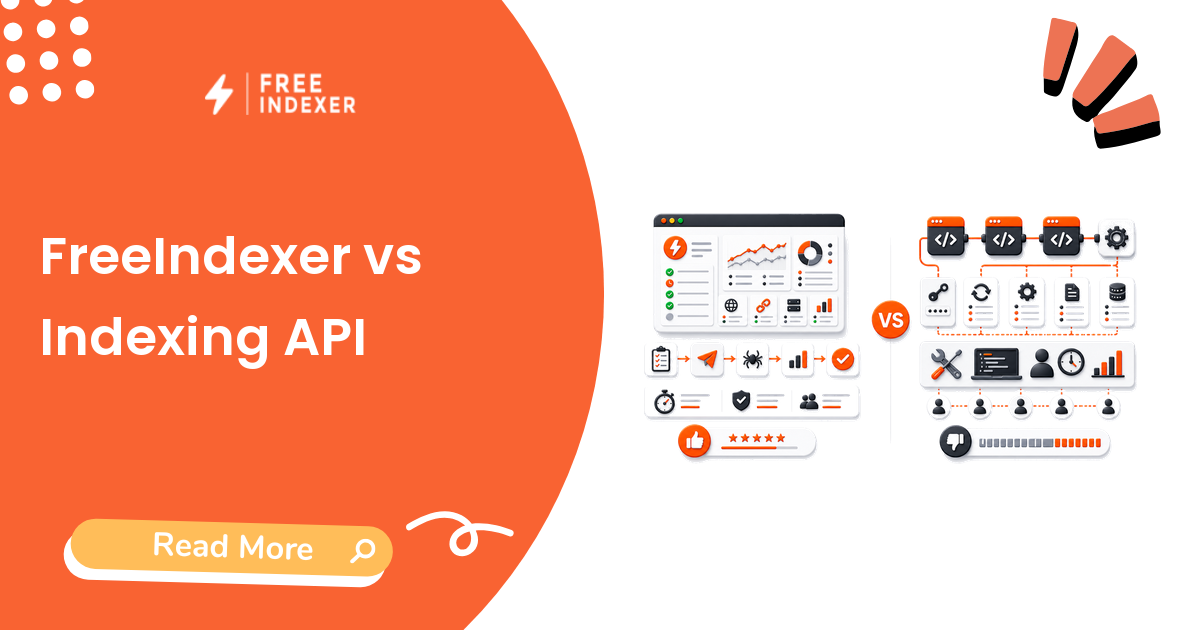
Comparison Table
| Dimension | FreeIndexer | API-style workflow |
|---|---|---|
| Setup time | Lower | Higher |
| Technical skill required | Low to moderate | Moderate to high |
| Maintenance | Tool-managed workflow | Team-owned integration |
| Best for | operators, agencies, affiliates, teams that want speed | engineering-led teams with custom systems |
| Workflow style | online app and desktop app path | custom automation |
| Cost model | plan/tool based | API plus engineering time |
| Control | practical workflow control | deeper system control |
| Risk | less technical overhead | more integration and maintenance risk |
When FreeIndexer Is The Better Fit
FreeIndexer is usually better when you want to start quickly.
It fits:
- website owners who do not want technical setup
- SEO agencies that need repeatable client submission workflows
- affiliate marketers submitting campaign URLs and backlinks
- blog/network owners working with URL lists
- SaaS teams adding indexing to a publishing checklist
- operators who prefer a desktop app for repeated list work
The main advantage is less operational friction. You do not need to design the whole system before you can submit URLs.
When An API-Style Workflow May Be Better
An API-style workflow may be better when submission needs to happen automatically inside your own software.
It can fit:
- programmatic SEO systems with automated publishing
- internal SEO platforms
- large content operations with engineering support
- custom dashboards that already manage URL status
- teams that need precise event-based submission triggers
The tradeoff is maintenance. Someone has to own authentication, errors, retries, logging, queue handling, and changes to the API contract.
The Hidden Cost Of API Workflows
API workflows can look efficient on paper, but they introduce operational responsibilities.
You need to answer:
- Who builds the integration?
- Who monitors failed submissions?
- Who handles rate limits?
- Who owns retry logic?
- Who updates the integration if requirements change?
- Where are submissions logged?
- How do non-technical team members use the workflow?
If you do not have clear answers, a ready tool is usually safer.
How Agencies Should Decide
Agencies usually need a workflow their team can run without engineering support. That makes FreeIndexer a practical fit for many agencies.
Use FreeIndexer when account managers, SEO specialists, or operators need to submit URLs and backlinks directly.
Consider an API-style system only if your agency has a technical product layer, high volume, and a clear reason to integrate indexing into internal software.
For the agency workflow, read the agency indexing workflow.
How Programmatic SEO Builders Should Decide
Programmatic SEO teams should decide based on publishing velocity and technical ownership.
If you publish pages manually or in controlled batches, FreeIndexer may be enough. If you publish thousands of URLs from a system and need submission tied to deployment events, an API-style workflow may eventually make sense.
Even then, do not automate submission before you automate quality checks. See the programmatic SEO indexing workflow for the prioritization model.
How Website Owners Should Decide
Most website owners do not need an API. They need a simple process:
- publish the page
- check the page
- submit the URL
- track the date
- review later
FreeIndexer fits that workflow better than a custom API system.
Expectations And Limits
Both options are submission workflows. Neither option controls search engine indexing decisions. A clean tool or API process can improve discovery operations, but it cannot replace page quality, crawlability, internal links, and useful content.
Example Build-Versus-Buy Calculation
Imagine an agency that submits 1,500 verified URLs and backlink source pages per month. A custom integration sounds attractive because submissions can connect directly to its campaign database. The decision should include more than API access:
| Cost area | FreeIndexer workflow | Custom API-style workflow |
|---|---|---|
| Initial setup | Configure users, queues, and rules | Design authentication, retries, logging, and interfaces |
| Ongoing maintenance | Product subscription and workflow ownership | Engineering time, failures, API changes, and monitoring |
| Quality control | Operator checks before upload | Must be designed into the internal system |
| Reporting | Export or tracker connected to submissions | Custom dashboards and evidence mapping |
| Flexibility | Product-supported features | Full control when engineering capacity exists |
If the agency has no developer assigned to own the system, the API path can become a brittle side project. If a SaaS platform already has a reliable publishing pipeline, URL inventory, observability, and an engineering owner, deeper automation may justify the cost.
The free URL indexer guide explains the simpler entry point, while the best Google indexing tools guide compares the wider category.
The final decision should name the responsible owner. “The technical team” is not an owner. Someone must maintain credentials, monitor failures, update integrations, and explain the submission evidence.
FAQ
Is FreeIndexer an indexing API?
Do not assume that unless the product owner confirms it. Treat FreeIndexer as an online and desktop indexing workflow unless official API details are provided.
Is an API always better for high volume?
Not always. High volume also needs prioritization, quality checks, and maintenance. A tool can be better if your team does not need deep integration.
Can FreeIndexer handle agency workflows?
Yes, it is a practical fit for agencies that need a repeatable submission process without custom infrastructure.
Can either option force Google to index URLs?
No. Both support discovery and submission workflows. Search engines make the indexing decision.
What should I choose if I am unsure?
Start with the simpler workflow. Move toward API-style integration only when you have a clear technical requirement.
Next Step
Choose FreeIndexer if you want a lower-maintenance indexing workflow for URLs and backlinks without building API infrastructure.