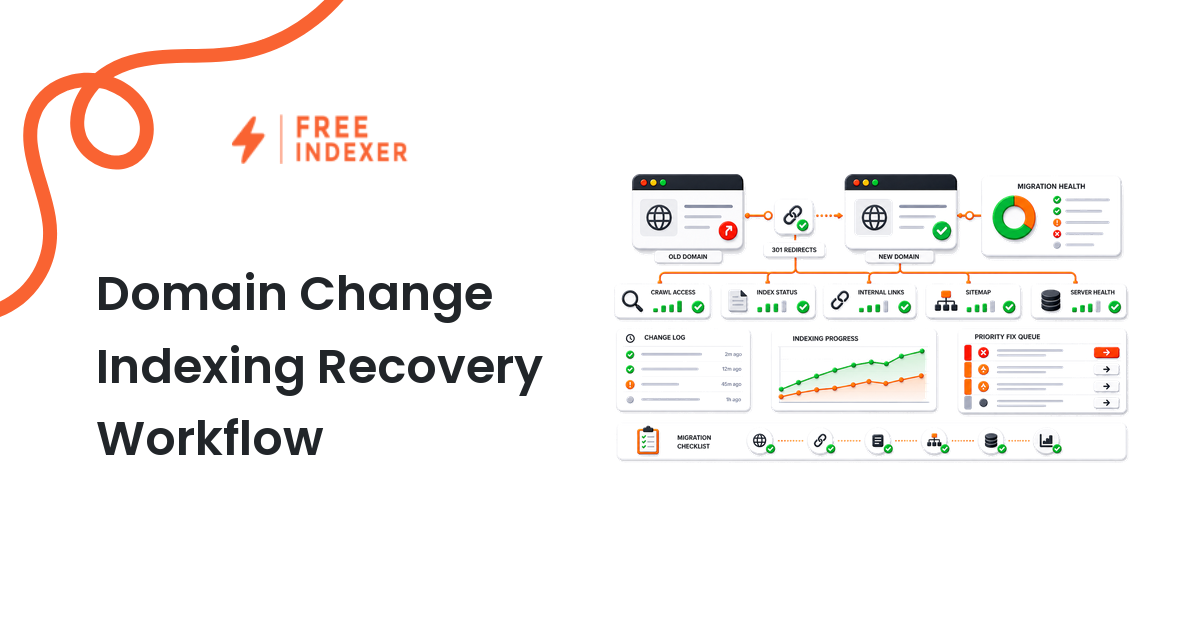
Recover after a domain change by checking redirects, ownership, canonicals, internal links, sitemaps, server logs, and old-domain availability.
For website owners, the practical goal is simple: Fix migration patterns in priority order and keep the old domain serving redirects.
Related FreeIndexer reading:
What The Signal Means
When the new domain is slow to appear, verify the migration as a system: old URLs, redirects, new responses, canonicals, sitemaps, Search Console ownership, and crawl capacity. One broken template can affect thousands of URLs.
Evidence To Collect Before Changing Anything
- The old domain should remain accessible and redirect directly to equivalent new URLs.
- The new domain needs complete ownership and monitoring in Search Console.
- Internal links, canonicals, hreflang, structured data, and sitemaps should use the new host.
- Migration processing happens URL by URL and can take time.
Diagnostic Decision Table
| Step | Check | Evidence To Capture | Corrective Action |
|---|---|---|---|
| 1 | Sample priority pairs | Old response, redirect, and new response | Fix chains, loops, 404s, and wrong destinations. |
| 2 | Audit new signals | Canonical, sitemap, links, and directives | Remove old-domain references. |
| 3 | Review Search Console | Properties, sitemaps, indexing reasons | Separate crawl errors from processing delays. |
| 4 | Check server logs | Googlebot activity on both domains | Confirm redirect and new-page crawling. |
| 5 | Prioritize recovery | Revenue, traffic, and link equity | Work from critical patterns outward. |
Work from the broadest shared cause toward the individual URL. If many pages share the same template, response code, canonical rule, or deployment, fix the pattern before treating every URL as a separate case.
Example Diagnosis
A domain move sends all old blog posts to the new blog homepage while product pages have correct mappings. Product visibility recovers, but blog traffic collapses. Restoring article-level redirects and updated canonicals addresses the affected section.
After the fix, test the current response again. Then allow enough time for recrawling and processing before deciding that the change failed.
Mistakes That Delay Recovery
- Taking the old domain offline.
- Leaving internal links on the old host.
- Using broad redirects that erase page intent.
- Assuming every delay is solved by more submissions.
Where FreeIndexer Fits
Use FreeIndexer for a controlled list of corrected new-domain URLs, especially high-value pages. Do not submit broken destination patterns at scale.
Implementation Notes For Each Step
1. Sample priority pairs
Capture old response, redirect, and new response before making a conclusion. Fix chains, loops, 404s, and wrong destinations.
Keep the evidence tied to the exact canonical URL and the date of the check. If the issue affects a shared template or URL pattern, record the pattern as well so the team fixes the system instead of repeating the same manual task.
2. Audit new signals
Capture canonical, sitemap, links, and directives before making a conclusion. Remove old-domain references.
Keep the evidence tied to the exact canonical URL and the date of the check. If the issue affects a shared template or URL pattern, record the pattern as well so the team fixes the system instead of repeating the same manual task.
3. Review Search Console
Capture properties, sitemaps, indexing reasons before making a conclusion. Separate crawl errors from processing delays.
Keep the evidence tied to the exact canonical URL and the date of the check. If the issue affects a shared template or URL pattern, record the pattern as well so the team fixes the system instead of repeating the same manual task.
4. Check server logs
Capture googlebot activity on both domains before making a conclusion. Confirm redirect and new-page crawling.
Keep the evidence tied to the exact canonical URL and the date of the check. If the issue affects a shared template or URL pattern, record the pattern as well so the team fixes the system instead of repeating the same manual task.
5. Prioritize recovery
Capture revenue, traffic, and link equity before making a conclusion. Work from critical patterns outward.
Keep the evidence tied to the exact canonical URL and the date of the check. If the issue affects a shared template or URL pattern, record the pattern as well so the team fixes the system instead of repeating the same manual task.
Turn The Findings Into An Action Queue
A diagnostic result is useful only when it changes what the team does next. Move each URL into one of four clear queues:
- Ready: the URL is useful, canonical, public, technically accessible, and ready for submission or normal monitoring.
- Fix: the URL has a correctable technical, content, linking, rendering, or reporting problem with an assigned owner.
- Exclude: the URL is intentionally redirected, noindexed, removed, duplicate, private, or otherwise outside the indexing target set.
- Escalate: the issue affects infrastructure, templates, migrations, security controls, or a large URL cohort and needs engineering or product input.
For this topic, the release rule is: Fix migration patterns in priority order and keep the old domain serving redirects. Do not leave a URL in a vague pending state. Give it an owner, one next action, and a review date based on the evidence available.
Evidence Log To Keep
| Field | What To Record | Why It Matters |
|---|---|---|
| Canonical URL | The final normalized URL checked by the operator | Prevents variants and redirects from splitting the investigation. |
| Cohort | Page type, template, campaign, locale, or backlink group | Reveals whether the issue is isolated or systemic. |
| Evidence source | Live response, URL Inspection, crawl, log, sitemap, or provider record | Makes the conclusion reproducible. |
| Change made | The exact technical, content, link, or workflow update | Separates action from assumption. |
| Owner and review date | Who is responsible and when the URL will be checked again | Stops the queue from becoming passive reporting. |
Keep submission dates in their own field. A submitted URL has completed an operational step; it has not automatically completed crawling, indexation, ranking, traffic, or conversion milestones. That separation makes the report more accurate and makes failed outcomes easier to diagnose.
Final Action Checklist
- [ ] Sample priority pairs: Fix chains, loops, 404s, and wrong destinations.
- [ ] Audit new signals: Remove old-domain references.
- [ ] Review Search Console: Separate crawl errors from processing delays.
- [ ] Check server logs: Confirm redirect and new-page crawling.
- [ ] Prioritize recovery: Work from critical patterns outward.
- [ ] Confirm the final URL and evidence date in the tracking sheet.
- [ ] Remove excluded or unresolved URLs from the active submission batch.
- [ ] Schedule one follow-up review instead of repeating untracked checks.
Primary Sources
FAQ
How long does a domain move take?
There is no fixed timeline. Size, server performance, URL mapping quality, and crawl frequency all matter.
Should the old domain stay renewed?
Yes. Keep control of it and maintain redirects to protect users and existing links.
Can I speed recovery with submissions?
Prioritized follow-up can help discovery, but technical migration quality remains the main requirement.
Next Step
Fix migration patterns in priority order and keep the old domain serving redirects.
Keep the final report honest: document what was fixed, what was submitted, what evidence changed, and what still requires time or a separate SEO decision.