Create a fast but controlled publishing workflow for timely articles using clean URLs, internal links, feeds, sitemaps, updates, and monitoring.
For content marketers, the practical goal is simple: Prepare discovery paths before publication so the article enters the site graph immediately.
Related FreeIndexer reading:
- Content Marketing That Gets Discovered
- Blog Publishing Checklist For Indexing
- New Blog Post Indexing Workflow
Quick Answer
Speed comes from preparation, not skipping QA. Use a stable canonical URL, publish complete content, connect it from relevant hubs, update feeds and sitemaps, and monitor whether the page is crawlable after release.
Signals That Matter
- Timely pages need a fast internal discovery path from sections crawlers already visit.
- RSS or Atom feeds can expose recent URLs alongside XML sitemaps.
- Major updates should preserve URL stability and clearly update visible dates when appropriate.
- Thin placeholders published early can create weak first impressions for users and crawlers.
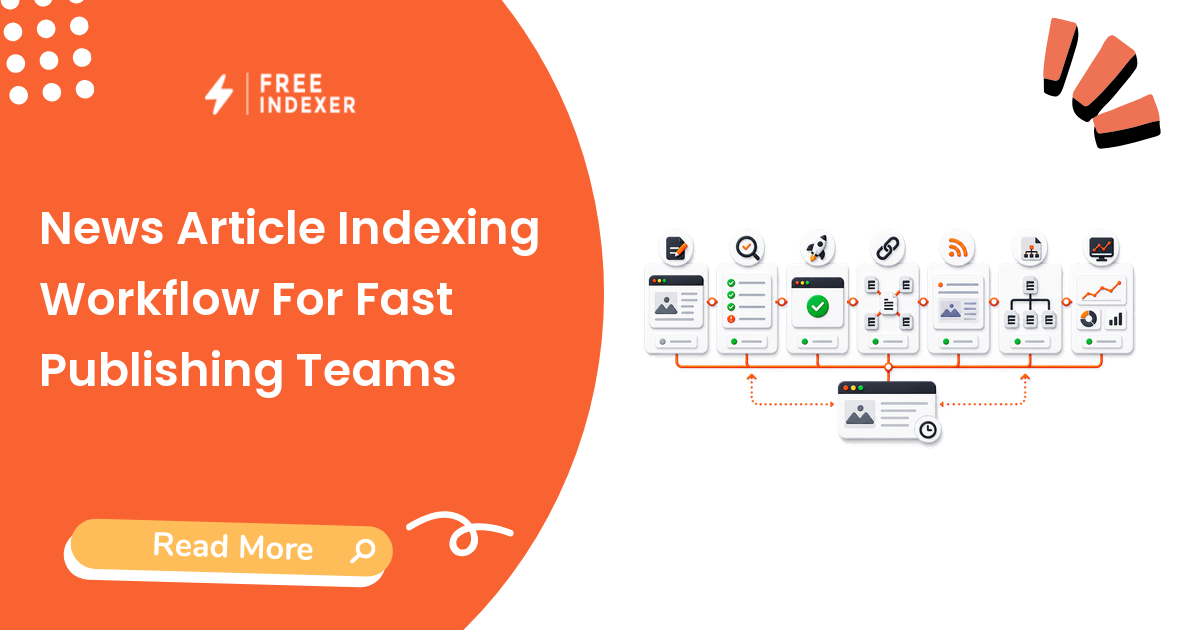
Step-By-Step Workflow
| Step | Check | Evidence To Capture | Next Action |
|---|---|---|---|
| 1 | Prepare the URL | Stable slug, canonical, and metadata | Avoid changing the path after promotion. |
| 2 | Run fast QA | Status, directives, content, author, and links | Block incomplete or duplicate drafts. |
| 3 | Publish discovery links | Homepage, section, related stories, and feed | Make the URL reachable immediately. |
| 4 | Update sitemap data | Canonical URL and meaningful modified time | Keep automated files accurate. |
| 5 | Monitor the release | Logs, inspection, errors, and engagement | Fix technical failures before promotion expands. |
A useful tracker keeps the evidence and the conclusion separate. Record what the URL returned, what the tool reported, what changed, who owns the next action, and when the page should be reviewed again.
Worked Example
A product company publishes a security update. The article is linked from the status hub and newsroom, included in the RSS feed, and added to the sitemap with an accurate update time. The team monitors the final URL rather than changing slugs as the story evolves.
The point of the example is not the exact numbers. It is the sequence: verify the real page, classify the issue, make one defensible change, and preserve enough evidence to evaluate the result later.
Common Mistakes
- Publishing a one-paragraph placeholder and filling it later.
- Changing the URL after social and external links exist.
- Leaving timely articles isolated from section hubs.
- Updating lastmod on every request rather than meaningful edits.
Where FreeIndexer Fits
FreeIndexer can add the final canonical URL to a rapid priority queue after publication QA. It should complement feeds, sitemaps, and internal links.
Implementation Notes For Each Step
1. Prepare the URL
Capture stable slug, canonical, and metadata before making a conclusion. Avoid changing the path after promotion.
Keep the evidence tied to the exact canonical URL and the date of the check. If the issue affects a shared template or URL pattern, record the pattern as well so the team fixes the system instead of repeating the same manual task.
2. Run fast QA
Capture status, directives, content, author, and links before making a conclusion. Block incomplete or duplicate drafts.
Keep the evidence tied to the exact canonical URL and the date of the check. If the issue affects a shared template or URL pattern, record the pattern as well so the team fixes the system instead of repeating the same manual task.
3. Publish discovery links
Capture homepage, section, related stories, and feed before making a conclusion. Make the URL reachable immediately.
Keep the evidence tied to the exact canonical URL and the date of the check. If the issue affects a shared template or URL pattern, record the pattern as well so the team fixes the system instead of repeating the same manual task.
4. Update sitemap data
Capture canonical url and meaningful modified time before making a conclusion. Keep automated files accurate.
Keep the evidence tied to the exact canonical URL and the date of the check. If the issue affects a shared template or URL pattern, record the pattern as well so the team fixes the system instead of repeating the same manual task.
5. Monitor the release
Capture logs, inspection, errors, and engagement before making a conclusion. Fix technical failures before promotion expands.
Keep the evidence tied to the exact canonical URL and the date of the check. If the issue affects a shared template or URL pattern, record the pattern as well so the team fixes the system instead of repeating the same manual task.
Turn The Findings Into An Action Queue
A diagnostic result is useful only when it changes what the team does next. Move each URL into one of four clear queues:
- Ready: the URL is useful, canonical, public, technically accessible, and ready for submission or normal monitoring.
- Fix: the URL has a correctable technical, content, linking, rendering, or reporting problem with an assigned owner.
- Exclude: the URL is intentionally redirected, noindexed, removed, duplicate, private, or otherwise outside the indexing target set.
- Escalate: the issue affects infrastructure, templates, migrations, security controls, or a large URL cohort and needs engineering or product input.
For this topic, the release rule is: Prepare discovery paths before publication so the article enters the site graph immediately. Do not leave a URL in a vague pending state. Give it an owner, one next action, and a review date based on the evidence available.
Evidence Log To Keep
| Field | What To Record | Why It Matters |
|---|---|---|
| Canonical URL | The final normalized URL checked by the operator | Prevents variants and redirects from splitting the investigation. |
| Cohort | Page type, template, campaign, locale, or backlink group | Reveals whether the issue is isolated or systemic. |
| Evidence source | Live response, URL Inspection, crawl, log, sitemap, or provider record | Makes the conclusion reproducible. |
| Change made | The exact technical, content, link, or workflow update | Separates action from assumption. |
| Owner and review date | Who is responsible and when the URL will be checked again | Stops the queue from becoming passive reporting. |
Keep submission dates in their own field. A submitted URL has completed an operational step; it has not automatically completed crawling, indexation, ranking, traffic, or conversion milestones. That separation makes the report more accurate and makes failed outcomes easier to diagnose.
Final Action Checklist
- [ ] Prepare the URL: Avoid changing the path after promotion.
- [ ] Run fast QA: Block incomplete or duplicate drafts.
- [ ] Publish discovery links: Make the URL reachable immediately.
- [ ] Update sitemap data: Keep automated files accurate.
- [ ] Monitor the release: Fix technical failures before promotion expands.
- [ ] Confirm the final URL and evidence date in the tracking sheet.
- [ ] Remove excluded or unresolved URLs from the active submission batch.
- [ ] Schedule one follow-up review instead of repeating untracked checks.
Primary Sources
FAQ
Do news articles need a special sitemap?
Some publishers use news sitemap extensions, but every workflow still needs clean, accessible canonical pages.
Should the publication date change after edits?
Keep publication and meaningful update information accurate and visible; avoid artificial freshness.
Can a fast article skip internal links?
No. Timely content benefits from immediate, relevant discovery paths.
Next Step
Prepare discovery paths before publication so the article enters the site graph immediately.
Keep the final report honest: document what was fixed, what was submitted, what evidence changed, and what still requires time or a separate SEO decision.