Bulk URL work fails when every URL gets treated as equal. A prioritization matrix helps SEO teams decide which URLs deserve submission, which need fixes, which can be monitored, and which should stay out of the queue.
For the wider discovery model, start with the indexing education hub. This guide is for operators managing large exports, client URL lists, programmatic pages, ecommerce categories, documentation sections, or backlink targets.
The Short Answer
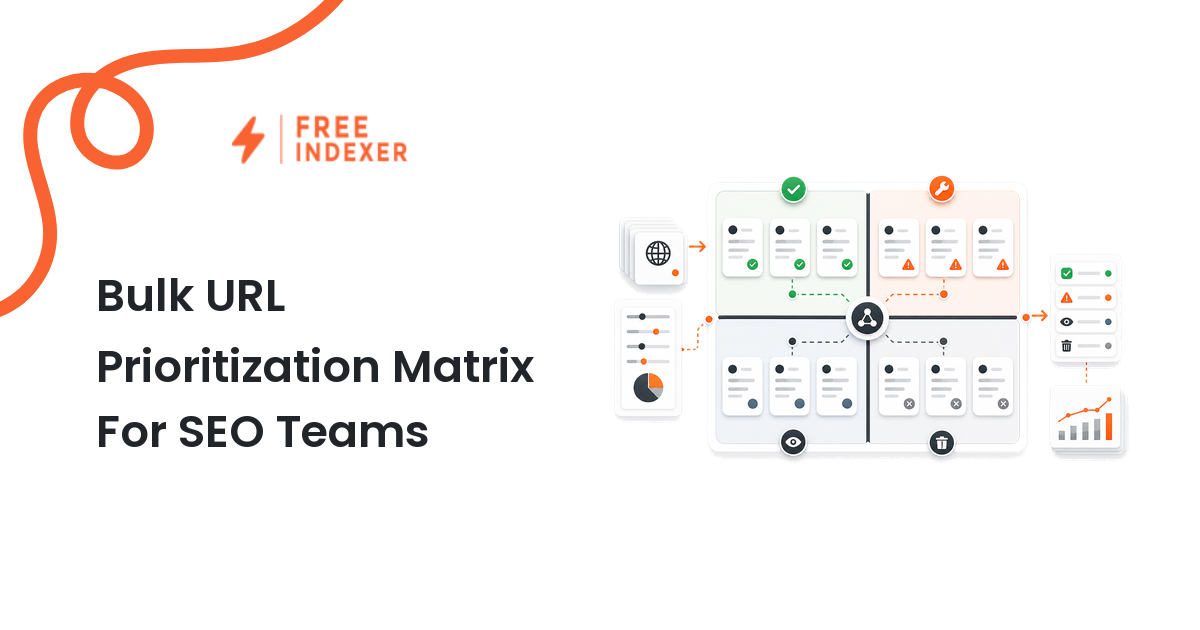
Prioritize bulk URLs by business value and readiness. A high-value URL that is crawlable, indexable, canonical, and useful belongs in the submit or track queue. A high-value URL with blockers belongs in the fix queue. A low-value URL should not consume the same attention.
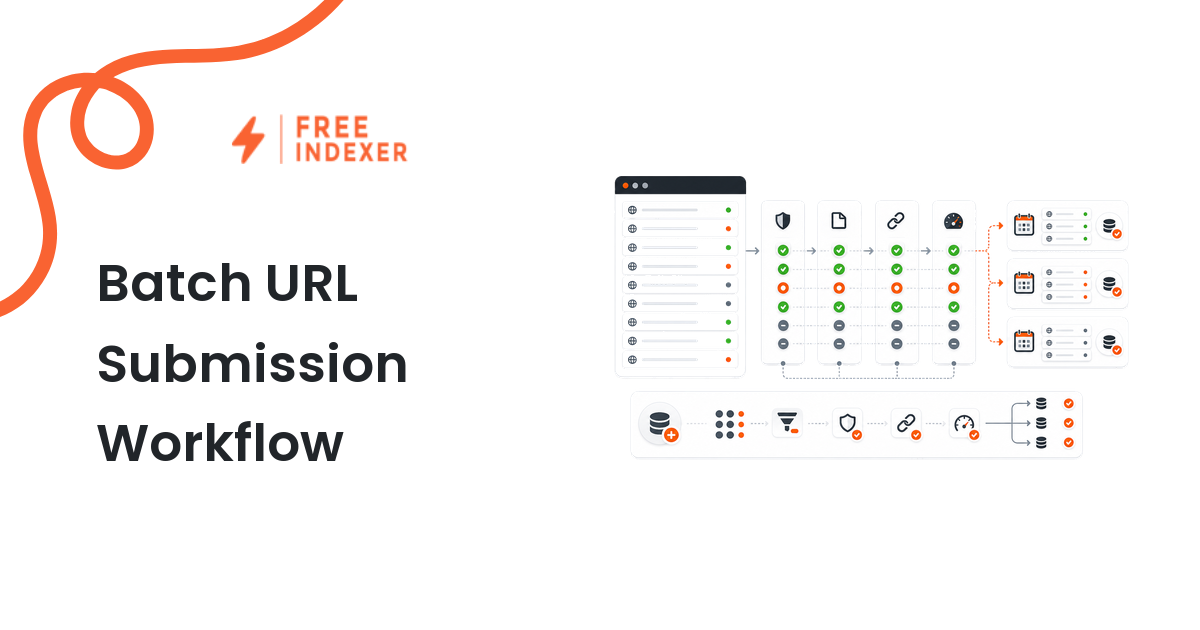
Use this matrix before running a bulk URL operations workflow or a batch URL submission workflow.
The Matrix
| Readiness / value | High business value | Low business value |
|---|---|---|
| Ready | Submit or track first | Monitor through sitemap and internal links |
| Not ready | Fix before submission | Exclude, consolidate, or improve later |
This simple grid prevents one of the most common bulk SEO mistakes: sending broken or low-value URLs into the same queue as revenue pages, new product pages, or campaign-critical content.
Scoring Fields
Add these fields to your URL inventory:
| Field | Score guide |
|---|---|
| Business value | Revenue page, lead page, product page, location page, client priority |
| Search demand | Clear query demand, supporting long-tail demand, or low/no demand |
| Content completeness | Complete, partial, thin, duplicate, empty |
| Crawlability | Allowed, blocked, unknown |
| Indexability | Index allowed, noindex, canonical elsewhere |
| Internal links | Strong, weak, orphaned |
| Sitemap status | Present, missing, should not be present |
| Freshness | New, meaningfully updated, stale |
| Follow-up cost | Easy to track, complex, unclear owner |
You do not need a perfect formula. You need consistent routing rules. Use how to prioritize URLs for indexing when you want a more detailed prioritization model.
Practical Checklist
Before a URL enters the priority queue, confirm:
- It is a final canonical URL.
- It returns a healthy status.
- It is not blocked by robots or
noindex. - It has a real reason to exist.
- It is internally linked from a relevant page.
- It is in the correct sitemap if it matters.
- It is tied to a business or campaign priority.
- Someone owns the follow-up.
If the URL fails one of these checks, route it to fix, improve, monitor, or exclude. Do not let the queue become a storage bin for uncertainty.
Decision Tree
- Is the URL important to the business or campaign?
- If no, monitor or exclude.
- Is the URL crawlable and indexable?
- If no, fix before submission.
- Is the URL canonical and useful?
- If no, consolidate or improve.
- Does the URL have internal links or sitemap discovery?
- If no, add discovery paths.
- Is follow-up worth the effort?
- If yes, submit or track.
Use daily indexing points planning if your team has a fixed daily capacity and needs to decide how many items from each tier to process.
Workflow Example
An SEO team exports 3,200 URLs after a content cleanup. The export includes:
- 120 product pages
- 400 blog posts
- 1,800 tag pages
- 500 redirected URLs
- 380 documentation pages
The matrix quickly separates the work. Product pages and important documentation URLs get reviewed first. Redirected URLs are excluded from submission. Tag pages are checked for indexation intent before any action. Blog posts with useful updates get a lower-priority follow-up group.
FreeIndexer fits the priority group after the matrix is applied. It can help with repeatable submission, tracking, and bulk operations for URLs that passed readiness checks. It should not process the entire raw export.
What To Do Next
| Matrix outcome | Queue | Action |
|---|---|---|
| High value and ready | Priority submit or track | Process first |
| High value and not ready | Fix queue | Assign owner and repair blocker |
| Low value and ready | Monitor | Let sitemap and internal links do the work |
| Low value and not ready | Exclude or improve | Remove from bulk operations |
| Unknown value | Review sample | Decide whether the template matters |
Common Mistakes
- Sorting only by publish date.
- Sending every sitemap URL into the same queue.
- Ignoring low-quality URL classes because the export is large.
- Forgetting to assign owners for fix queues.
- Measuring work by submitted count instead of qualified priority count.
FAQ
What is a bulk URL prioritization matrix?
It is a routing model that classifies URLs by readiness and business value so teams know whether to submit, fix, monitor, or exclude each group.
Should every URL in a bulk list be submitted?
No. Submit or track URLs that are important and ready. Fix blocked or weak URLs first and exclude URLs that should not be indexed.
How do I prioritize programmatic SEO URLs?
Prioritize templates and URLs with clear demand, complete content, crawlable paths, self-canonical signals, and internal links.
Where does FreeIndexer fit?
Use FreeIndexer for the qualified priority queue after you have filtered the raw export.
Next Step
Prioritize URL batches by business value, readiness, and follow-up cost. A smaller qualified queue usually beats a larger noisy one.